
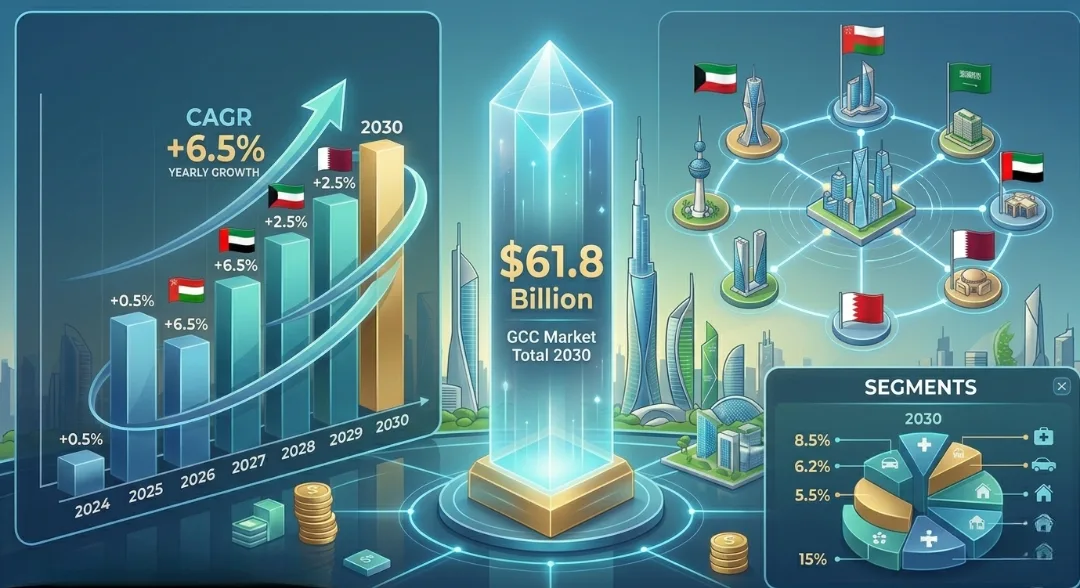
The Gulf Cooperation Council (GCC) insurance industry is on track for steady expansion over the next five years, with total gross written premiums expected to rise from $48.5 billion in 2025 to $61.8 billion by 2030, according to the latest GCC Insurance Industry Report 2026 by Alpen Capital.
The report forecasts an annual growth rate of 4.9 percent through 2030, driven by large-scale infrastructure projects, expanding populations, mandatory insurance schemes, and the rapid digital transformation taking place across Gulf economies.
As governments continue diversifying their economies and consumers become more aware of financial protection products, the insurance industry is evolving into a more technology-driven and customer-focused sector.
Non-Life Insurance Remains the Industry's Biggest Growth Engine
The report shows that non-life insurance will continue to dominate the GCC market throughout the decade.
Premiums in this segment are projected to increase from $42.1 billion in 2025 to $54.1 billion by 2030, representing an annual growth rate of 5.2 percent. By the end of the decade, non-life insurance is expected to account for nearly 88 percent of the region's total insurance market.
This category includes products such as:
- Motor insurance
- Health insurance
- Property insurance
- Marine and cargo insurance
- Liability and business coverage
Meanwhile, the life insurance segment is forecast to grow at a more moderate pace. Premiums are expected to rise from $6.4 billion to $7.7 billion between 2025 and 2030, with a CAGR of 3.5 percent.
While life insurance adoption remains lower compared to global markets, rising financial awareness and wealth creation across the Gulf are expected to support gradual growth.
Infrastructure and Population Growth Fuel Demand
Several long-term trends are creating favorable conditions for insurers across the region.
Alpen Capital highlighted a number of major growth drivers, including:
- Expanding populations across GCC countries
- Multi-billion-dollar infrastructure and mega projects
- Wider implementation of mandatory insurance policies
- Greater awareness of financial protection and risk management
- Ongoing economic diversification programs
As a result, insurance spending per person—known as insurance density—is expected to rise significantly, increasing from $775.3 in 2025 to around $907.5 by 2030.
However, insurance penetration rates are expected to remain relatively stable, reflecting the maturity of some markets and ongoing structural challenges within the industry.
Challenges Continue to Pressure Profitability
Despite positive growth prospects, the GCC insurance sector still faces several challenges that could impact profitability.
According to the report, insurers are operating in an increasingly competitive environment marked by:
- Fragmented market structures
- High operating costs
- Rising reinsurance expenses
- Oil price fluctuations
- Geopolitical uncertainty
- Softer investment returns
The report notes that volatility in global energy markets can influence economic activity across Gulf countries, which in turn affects demand for insurance products in sectors such as travel, logistics, and trade.
As competition intensifies, insurers are increasingly looking at efficiency improvements, strategic partnerships, and digital innovation to protect margins and strengthen market positions.
Saudi Arabia Leads Regional Growth
Among GCC countries, Saudi Arabia is expected to remain the region's largest and fastest-growing insurance market.
The Saudi insurance sector is projected to expand at an annual rate of 5.9 percent between 2025 and 2030. Growth is being supported by:
- Major infrastructure developments
- Expanding healthcare services
- Regulatory reforms
- Rising demand for mandatory insurance products
Kuwait is expected to record the second-highest growth rate at 5.5 percent, driven by population growth and public investment projects.
Meanwhile, the UAE, one of the Gulf's most mature insurance markets, is forecast to grow steadily at 4.1 percent annually. The country's focus on innovation and digital transformation continues to reshape the insurance landscape and create new opportunities for insurers.
Digital Transformation Is Changing the Industry
Technology is becoming one of the most important forces shaping the future of insurance across the GCC.
Consumers increasingly expect faster, simpler, and more personalized services, pushing insurers to invest heavily in digital capabilities and insurtech solutions.
The report highlights growing adoption of technologies aimed at improving:
- Underwriting and risk assessment
- Claims processing
- Customer service and engagement
- Online distribution channels
- Data analytics and fraud prevention
Demand is also rising for specialized insurance products, particularly in emerging risk categories such as:
- Cyber insurance
- Political risk insurance
- Marine insurance
- War-risk coverage
As digital adoption accelerates, the industry is expected to witness more mergers and acquisitions, allowing larger insurers to expand their reach and strengthen their competitive position.
Outlook Remains Positive
While challenges related to profitability and geopolitical uncertainty remain, the long-term outlook for the GCC insurance market remains encouraging.
Economic diversification, expanding infrastructure, regulatory reforms, and rapid technological adoption are creating a strong foundation for future growth. As insurers adapt to changing customer expectations and invest in digital capabilities, the industry is expected to become more efficient, competitive, and resilient.
With Saudi Arabia leading expansion and the UAE driving innovation, the GCC insurance sector is entering a new phase—one defined not just by growth, but by transformation.